

The marketing world is transforming at a pace never seen before. Companies face new challenges as technology evolves, consumer behaviors shift, and competition intensifies.
To succeed in 2026, organizations must stay agile and embrace innovation. Adapting to emerging trends and leveraging the best company marketing strategies is crucial for gaining a competitive edge.
This article explores nine essential strategies designed to help businesses thrive in the future. Discover actionable insights that will empower your team, drive growth, and ensure lasting impact in a rapidly changing landscape.
The Changing Landscape of Company Marketing in 2026
The marketing world is experiencing a seismic shift as we approach 2026. Rapid technological advancements, evolving consumer expectations, and fierce competition are fundamentally altering how brands connect with audiences. To succeed, organizations must embrace the best company marketing strategies and prepare for ongoing transformation.
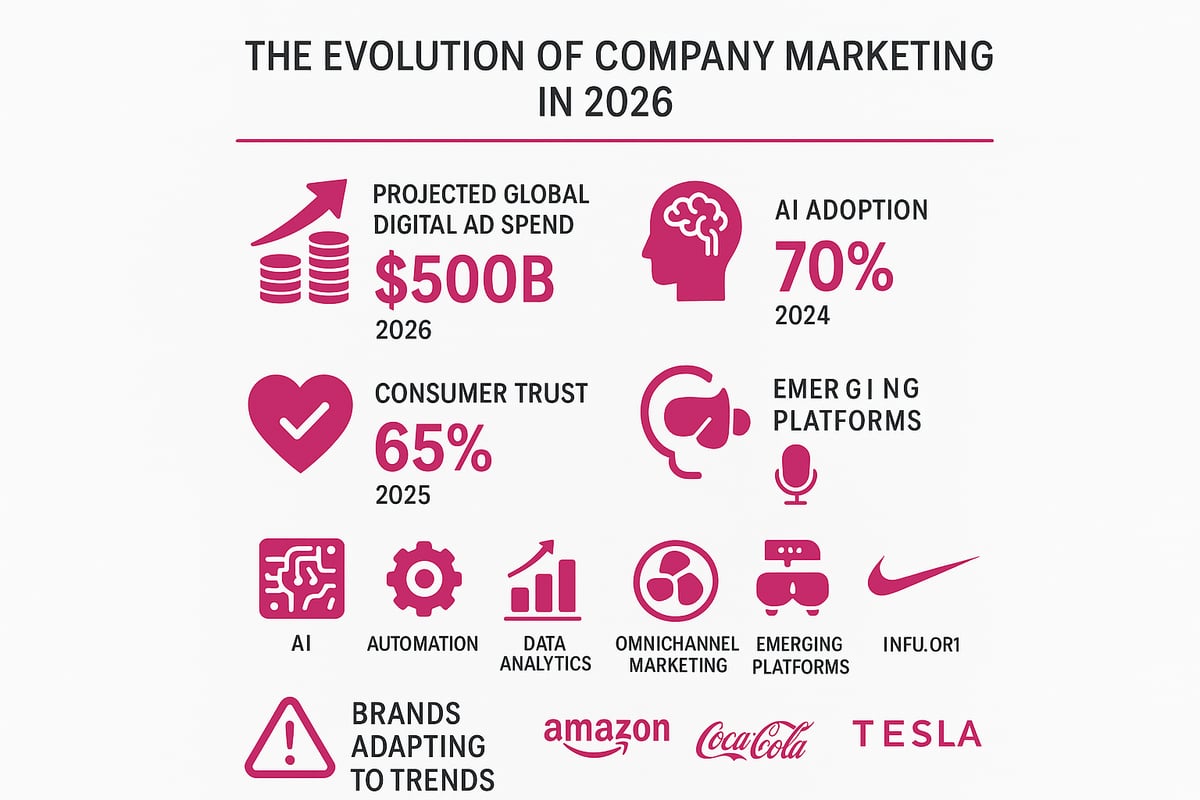
Artificial intelligence, automation, and data analytics are now at the core of the best company marketing strategies. Brands leverage machine learning for predictive analytics, automate campaign management, and use real-time data to optimize every touchpoint. These technologies not only improve efficiency but also enable brands to deliver more relevant and timely experiences.
Consumer behavior is evolving just as quickly. Shoppers now expect hyper-personalized interactions tailored to their unique preferences. At the same time, privacy concerns are more prominent, driving demand for transparent data practices. Authentic engagement is a must, as audiences gravitate toward brands that communicate openly and foster genuine connections.
Omnichannel experiences are rising in importance. Customers interact with companies across digital and physical channels, from social media and websites to in-store and mobile apps. Integrated marketing campaigns ensure consistent messaging and brand identity at every stage. Alongside this, sustainability and purpose-driven values are shaping purchasing decisions, with buyers seeking out brands that align with their ethical expectations.
Emerging platforms are reshaping the marketing landscape. New social networks, voice search, and immersive technologies like augmented and virtual reality are creating fresh opportunities for engagement. Companies that quickly adapt to these channels can differentiate themselves and reach audiences in innovative ways.
| Key Statistic | 2024–2025 Data |
|---|---|
| Global Digital Ad Spend | $740B projected by end of 2025 |
| AI Adoption in Marketing | 85% of companies integrating AI tools |
| Consumer Trust in Brands | 62% prioritize brands with transparent values |
Several brands are already leading the way. For example, a global retailer increased loyalty with personalized product recommendations powered by AI, while a consumer goods company grew market share through sustainability-focused campaigns. However, many organizations face challenges in keeping pace with innovation. Limited resources, technology integration, and rapidly shifting regulations can complicate the adoption of the best company marketing strategies.
To navigate this landscape, companies should continuously monitor trends, invest in upskilling teams, and seek resources that provide actionable insights. For a comprehensive overview of tactics and trends shaping the future, consult the Essential Marketing Guide for 2026, which details strategies that can help organizations thrive amid change.
In summary, the changing landscape of company marketing in 2026 demands agility, innovation, and a commitment to customer-centricity. By staying informed and proactive, businesses can implement the best company marketing strategies to achieve growth and build lasting relationships with their audiences.
9 Essential Best Company Marketing Strategies for 2026
In 2026, companies must rethink their approach to stay ahead in a hyper-competitive, tech-driven marketplace. The best company marketing strategies do not just follow trends—they anticipate them, delivering value through innovation, personalization, and purpose. Here are nine strategies every forward-thinking business should prioritize for sustainable growth.
1. [Hyper-Personalized Customer Journeys]
Personalization has evolved from a nice-to-have to a critical pillar of the best company marketing strategies. In 2026, brands are leveraging advanced AI and big data analytics to deliver individualized content, offers, and experiences at every touchpoint.
- Dynamic Experiences: Websites adapt in real-time, presenting products and content based on each visitor’s interests, purchase history, and behaviors.
- Personalized Campaigns: Email and retargeting campaigns use predictive analytics to send the right message at the right time.
- Case Study: A leading retail company implemented AI-powered product recommendations, resulting in a 30% increase in conversions and higher customer satisfaction.
This level of customization drives higher engagement, loyalty, and conversion rates. However, companies must address data privacy concerns and invest in robust tech infrastructure to execute these best company marketing strategies effectively.
2. [Omnichannel Marketing Integration]
Seamless brand experiences are at the core of the best company marketing strategies for 2026. Omnichannel integration ensures that messaging, branding, and customer interactions are consistent across digital and physical touchpoints.
- Unified Customer Profiles: Brands consolidate data from social, web, email, mobile, and in-store to build comprehensive customer views.
- Coordinated Messaging: Marketing automation platforms orchestrate campaigns for maximum impact and reach.
- Example: A global cosmetics brand uses unified profiles to deliver consistent promotions, whether customers shop online, via app, or in-store, resulting in improved satisfaction and retention.
The benefits include increased reach, stronger brand recall, and higher customer satisfaction. Key considerations involve integrating disparate data sources and maintaining a coherent brand voice across platforms.
3. [AI-Driven Content Creation and Curation]
AI is transforming content marketing, a trend central to the best company marketing strategies. Companies now use generative AI tools for copywriting, video creation, and design, enabling rapid, scalable production of high-quality assets.
- Automated Distribution: AI platforms optimize content delivery across channels, tailoring formats and timing for each audience segment.
- Case in Point: A major media company scaled its output significantly by combining human creativity with AI-powered content generation, freeing teams to focus on strategy and storytelling.
This approach delivers efficiency, scalability, and cost savings. However, over-reliance on automation can lead to generic messaging, so human oversight remains essential. For more on how AI is shaping the future of marketing, explore AI’s Impact on E-commerce in 2026.
4. [Influencer and Community-Driven Campaigns]
Authentic engagement is a cornerstone of the best company marketing strategies. In 2026, brands increasingly partner with micro-influencers and nurture online communities to drive organic reach and trust.
- Ambassador Programs: Brands recruit passionate customers as advocates, amplifying messages naturally.
- Community Building: Dedicated forums and social groups foster ongoing dialogue, feedback, and loyalty.
- Example: A niche wellness brand built a thriving ambassador program, resulting in a 40% boost in word-of-mouth referrals.
While this strategy offers authentic reach and credibility, brands must carefully vet influencers for alignment and monitor community sentiment to safeguard reputation.
5. [Sustainable and Purpose-Driven Branding]
Modern consumers demand more than quality—they want brands to reflect their values. The best company marketing strategies in 2026 align with environmental and social causes to build lasting connections.
- Transparency: Companies openly share their sustainability initiatives and impact metrics.
- Purpose-Led Campaigns: Marketing highlights authentic commitments, not just surface-level claims.
- Example: A leading apparel company saw double-digit growth after launching a campaign showcasing its eco-friendly production process.
This approach attracts conscious consumers and differentiates brands. However, it is vital to avoid greenwashing and ensure every claim is backed by real action.
6. [Voice Search and Conversational Marketing]
Voice-enabled devices and conversational AI are rapidly changing how customers interact with brands. The best company marketing strategies now include optimizing content for voice search and deploying intelligent chatbots for real-time support.
- Voice Optimization: Content is structured with natural language and FAQs to improve visibility in voice search results.
- Conversational Engagement: AI chatbots handle queries instantly, enhancing accessibility and satisfaction.
- Example: A service provider improved customer response times and satisfaction by integrating conversational AI across channels.
Benefits include faster responses and greater convenience, but companies must continuously refine conversational interfaces to meet evolving expectations.
7. [Data Privacy and Ethical Marketing]
Trust is foundational to the best company marketing strategies. With stricter privacy regulations like GDPR and CCPA, brands must prioritize transparent, consent-based data practices.
- Clear Consent: Companies provide easy-to-understand privacy options and honor customer choices.
- Trust Signals: Transparent data use policies and visible security measures foster confidence.
- Example: A fintech brand built loyalty by making privacy a core message, leading to increased customer retention.
Although compliance can be complex, prioritizing ethics protects brand reputation and strengthens long-term relationships.
8. [Agile Marketing Teams and Processes]
The pace of change in 2026 demands agility. The best company marketing strategies rely on teams that embrace rapid iteration, cross-functional collaboration, and data-driven decision-making.
- Agile Sprints: Campaigns are launched, tested, and optimized quickly to capitalize on emerging trends.
- Collaborative Culture: Diverse skills—creative, technical, analytical—work together seamlessly.
- Example: A fast-growing startup adopted agile marketing, doubling ROI and accelerating campaign timelines.
While transitioning to agile requires mindset shifts and training, the payoff is greater flexibility and improved responsiveness.
9. [Immersive Experiences: AR, VR, and Interactive Content]
Immersive technology is redefining brand engagement. The best company marketing strategies now incorporate augmented reality, virtual reality, and interactive content to create memorable experiences.
- AR/VR Campaigns: Retailers offer virtual try-ons and 360-degree product views, increasing dwell time and conversions.
- Interactive Content: Quizzes, polls, and gamified elements boost engagement and data collection.
- Example: A footwear brand used AR to let customers visualize shoes at home, resulting in a 25% sales lift.
While investment and tech adoption can be challenging, immersive experiences set brands apart in a crowded market.
Building a Future-Ready Marketing Team
The success of the best company marketing strategies in 2026 will depend on building teams that are equipped for a rapidly changing environment. As technology, platforms, and consumer expectations evolve, companies must rethink not only what their teams do but also how they work together. A future-ready marketing team is agile, diverse in expertise, and always learning.
Essential Skills and Roles for 2026
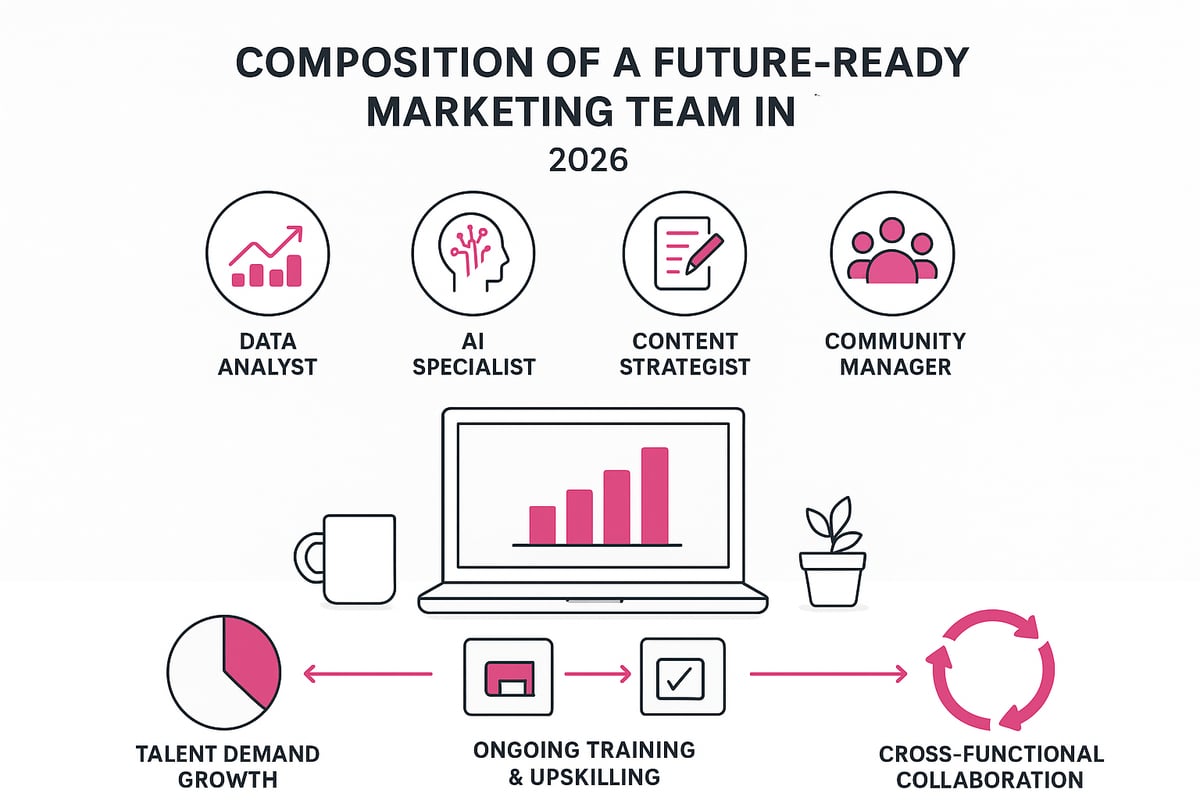
To implement the best company marketing strategies, organizations will need to assemble teams with a blend of technical, creative, and strategic skills. The marketing department of tomorrow will feature:
| Role | Core Skillset | Impact on Strategy |
|---|---|---|
| Data Analyst | Data mining, analytics | Personalization, campaign insights |
| AI Specialist | Machine learning, automation | AI-driven content and optimization |
| Content Strategist | Storytelling, SEO | Brand voice, multi-channel content |
| Community Manager | Engagement, moderation | Authentic connections, loyalty |
Demand for hybrid roles that combine analytical and creative thinking will continue to rise. Companies that proactively align their hiring and team structure to the best company marketing strategies will be better positioned to adapt to new technologies and platforms.
Ongoing Training and Upskilling
The pace of change in marketing requires a commitment to continuous learning. Upskilling is not just a trend, it is a necessity for teams aiming to execute the best company marketing strategies. Training programs should focus on:
- AI and automation tools
- Data privacy regulations
- Cross-channel campaign management
- Emerging creative formats
Investing in certifications, workshops, and internal knowledge sharing helps teams stay ahead. Resources such as Branding and Advertising Tips can complement training efforts by offering strategic guidance relevant to modern marketing roles.
Fostering Innovation and Cross-Functional Collaboration
A culture of experimentation and collaboration is critical for future-ready teams. Agile working methods, such as sprints and rapid prototyping, enable teams to test ideas quickly and respond to trends. Cross-functional teams bring together diverse expertise, breaking down silos and accelerating campaign delivery.
For example, companies restructuring their teams to blend data analysts with creatives and tech specialists have reported improved agility and measurable results. As talent demand for these hybrid teams increases, organizations must prioritize open communication and shared goals to maximize the impact of the best company marketing strategies.
Building a future-ready marketing team is not just about hiring new talent, it is about creating an environment where people can adapt, innovate, and thrive together.
Measuring Success: KPIs and Analytics for 2026 Marketing Strategies
Measuring the impact of your best company marketing strategies in 2026 requires a new level of precision. As marketing becomes more complex, companies must track performance using advanced key performance indicators that reflect the full customer journey.
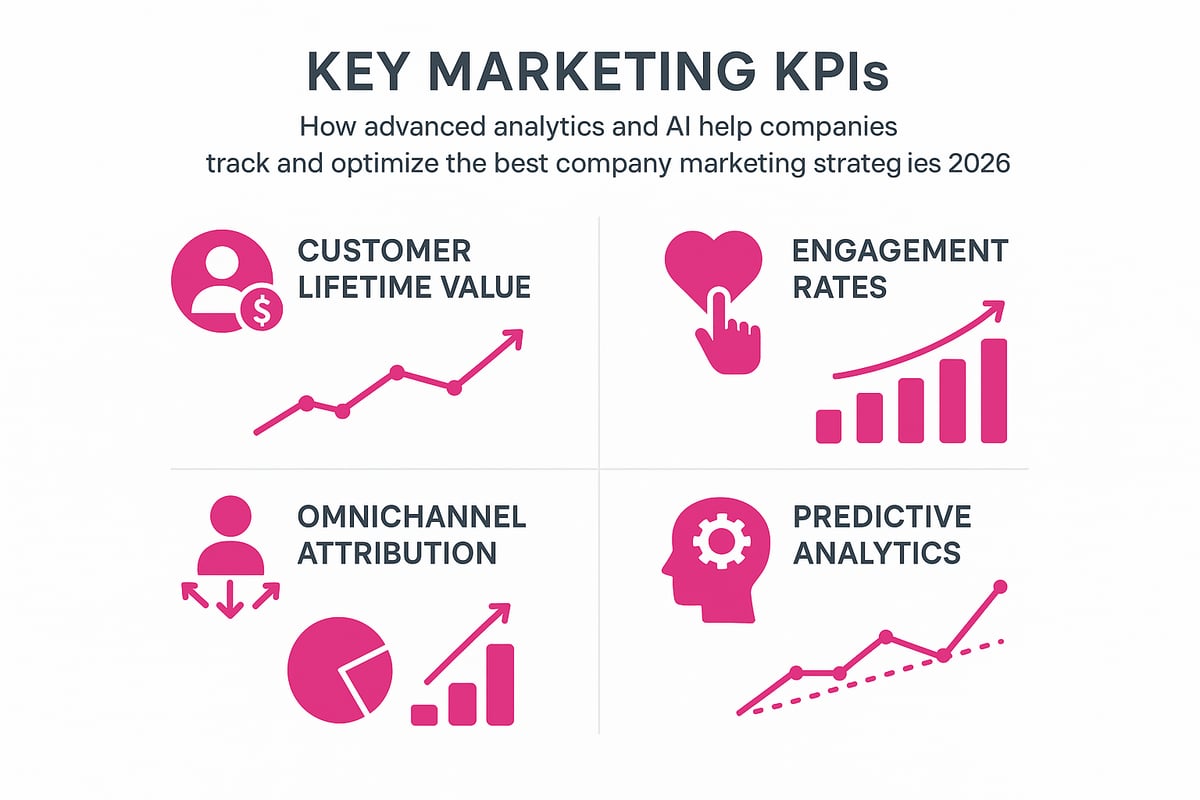
Below is a quick overview of essential KPIs for modern marketing:
| KPI | What It Measures | Why It Matters |
|---|---|---|
| Customer Lifetime Value | Total value a customer brings | Guides acquisition investment |
| Engagement Rate | Interactions per audience size | Reveals content effectiveness |
| Omnichannel Attribution | Credit for conversions across channels | Optimizes budget allocation |
| Predictive Analytics | Forecasts future behaviors | Enables proactive strategies |
Today’s marketers leverage AI-powered analytics tools for real-time insights. These platforms analyze massive datasets to uncover patterns, optimize campaigns, and personalize experiences. For example, one global retailer used predictive analytics to adjust ad spend, resulting in a 15% increase in return on investment within one quarter.
It is essential to tie every KPI to core business outcomes. Tracking only vanity metrics will not reveal the true impact of your best company marketing strategies. Instead, focus on metrics that drive growth, retention, and profitability.
For continuous improvement, schedule regular reviews of your analytics dashboard. Test new approaches, monitor results, and refine your strategy based on actionable data. For more ways to align your analytics with company goals, explore Strategic Digital Marketing Insights.
As you’ve seen, marketing in 2026 will demand agility, innovation, and a willingness to embrace new technology and changing consumer expectations. Whether you’re curious about integrating AI, building authentic brand loyalty, or crafting immersive experiences, the path to growth starts with a tailored strategy. At Kreative Angle, we help Calgary businesses like yours stand out and scale up by turning insight into action. If you’re ready to make your brand impossible to ignore and want expert guidance on implementing these proven strategies, let’s talk about your goals. Get Started